Disabled Habitus is a multimedia exhibition that positions disability as a valuable and essential expression of biodiversity. Created by a visibly disabled artist, the works resist narratives that cast disability as tragedy, deficiency, or failure. Instead, they present disabled embodiment as a record of creativity, ingenuity, and survival.
Through reimagined motion studies and representations of disability in the natural world, the exhibition challenges pathologized framings of difference by pointing to the universality and therefor neutrality of “deviation.” Hand-traced choreographies of disabled performers are layered into a looping visual grid, recalling early scientific illustrations and echoing botanical and entomological diagrams. These animations allow disabled movement to take up space—beyond diagnosis, beyond spectacle.
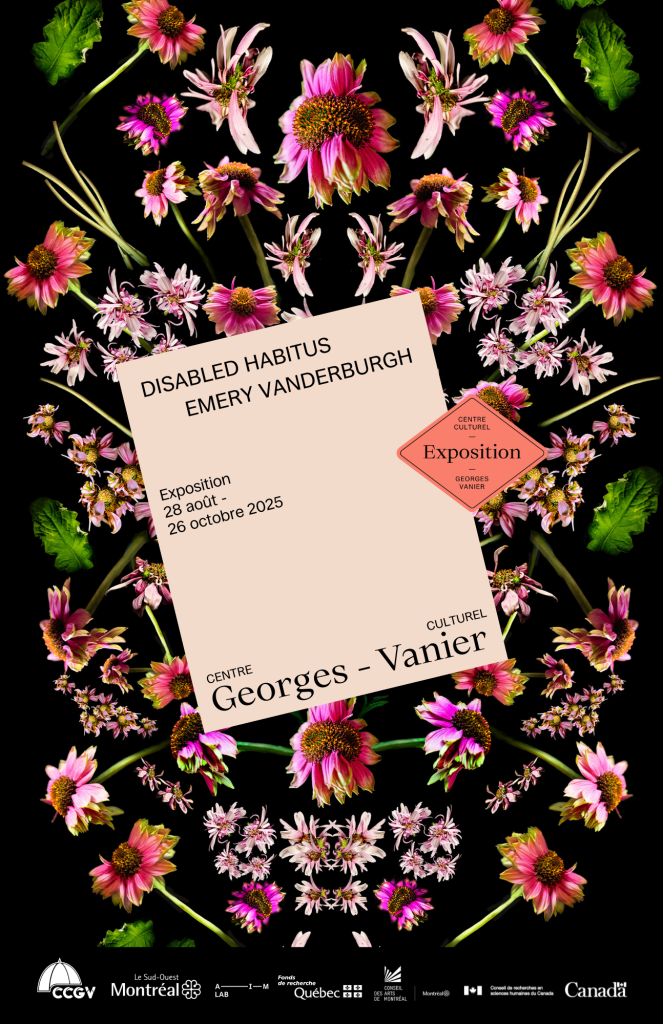
Elsewhere, floral mutations—conjoined petals, crested stems, warped growths—are collected and explored as nonhuman representations of disability. By shifting disability away from a solely human context, the exhibition reveals how systems rooted in white supremacy, colonialism, eugenics, and ableism define which lives are valued and which are expendable. Just as monocultures in agriculture suppress variation, these ideologies favor uniformity, making our ecosystems and societies more fragile.
Both the animated choreographies and mutant blooms are provocations: Why do we meet biological irregularity in plants with wonder, but disabled bodies with discomfort? This space invites you to consider disability not as a diagnosis, but as diversity: a generative force, a critical lens, and a vital part of our ecological survival¹.
This project was made possible through the Fonds de recherche du Québec’s Engage 2022-23 program, in collaboration with Dr. Arseli Dokumaci. The exploration of materials for this work is a micro-project undertaken by Emery Vanderburgh as part of the project “Mobilizing Disability Survival Skills for Anthropocene Emergencies” (MDSSA), funded by a grant from the Social Sciences and Humanities Research Council of Canada (SSHRC) (PI, Arseli Dokumaci). The Disabled Body In Motion and Still Life were created with the support of the Conseil des arts de Montréal.
¹ This work has been deeply informed by Arseli Dokumaci’s book, Activist Affordances, with its description of a “disabled habitus” and ecological disability.
Exhibition at McClure Gallery

- Victoria Arts Centre, 350 Victoria Avenue
- November 6 to December 13, 2025
- Vernissage November 6
- Free Art Hive – Making Mutant Flowers – November 22 10:30-1pm (info here)
- Free Roundtable – Disability Art In Motion – November 22 3:30-5:30 (info here)
Exhibition at Georges-Vanier Cultural Centre
- August 28 to October 26, 2025
- Vernissage September 4
 Emery Vanderburgh